 Русский
 Հայերեն
Antalya is great because you can fit several versions of Turkey into one trip: an old Ottoman city, Roman ruins, waterfalls, beaches, mountains, and even a longer outing to the white terraces of Pamukkale. If you are looking for what to see in Antalya in a week, do not try to travel to the opposite end of the coast every day. It is better to alternate city walks, short trips, and a couple of packed days with an early start.
Below is an itinerary that does not feel like a race, but still includes the main places: Kaleiçi and Hadrian's Gate, Düden and Kurşunlu, Perge and Aspendos, Side, Kemer, Tahtalı, Olympos, Chimera, and Pamukkale. It is easy to adapt whether your hotel is in the center, Lara, Konyaaltı, or near the Otogar bus station.
How to plan a week in Antalya: transport, season, and where to stay
For a first trip, it is most convenient to stay in Kaleiçi, Muratpaşa, Konyaaltı, or Lara. Kaleiçi is at its most beautiful in the evening, but not everyone will enjoy dragging a suitcase over cobblestones. Konyaaltı is good for travelers who want the beach and mountains on the horizon. Lara is usually chosen for its hotels and proximity to the airport.
Around the city, you will use the tram, buses, dolmuş minibuses, and taxis. For public transport you need an Antalyakart: you top it up at machines and kiosks, and tap it when boarding. It is best to have a transport card. The tram runs from the airport into the city, and the bus station is easy to reach by tram or bus.
Dolmuş minibuses are useful for short routes along the coast and between neighboring resort towns. For farther places like Side, Kemer, or Pamukkale, it is more comfortable to rent a car, take an organized tour, or go by intercity bus from Otogar. Taxis can be ordered through BiTaksi; in tourist areas, it is better to confirm the price before getting in, especially if you are heading out of town.
The season has a big impact on the itinerary. Spring and fall are better for ruins and hikes: it is not as hot, and the light is softer for photos. In summer, visit archaeological sites in the morning, and leave waterfalls and the sea for the second half of the day. You can check the weather by month in our guide Weather in Turkey by month.
For maps, taxis, menu translation, and staying in touch with a guide, it is convenient to set up a tourist eSIM for Turkey in advance on the /strana/turkey page, especially if you plan to leave the city and do not want to look for a mobile operator store on your first day.
Day 1 and 2: Kaleiçi, Hadrian's Gate, Düden, and Kurşunlu
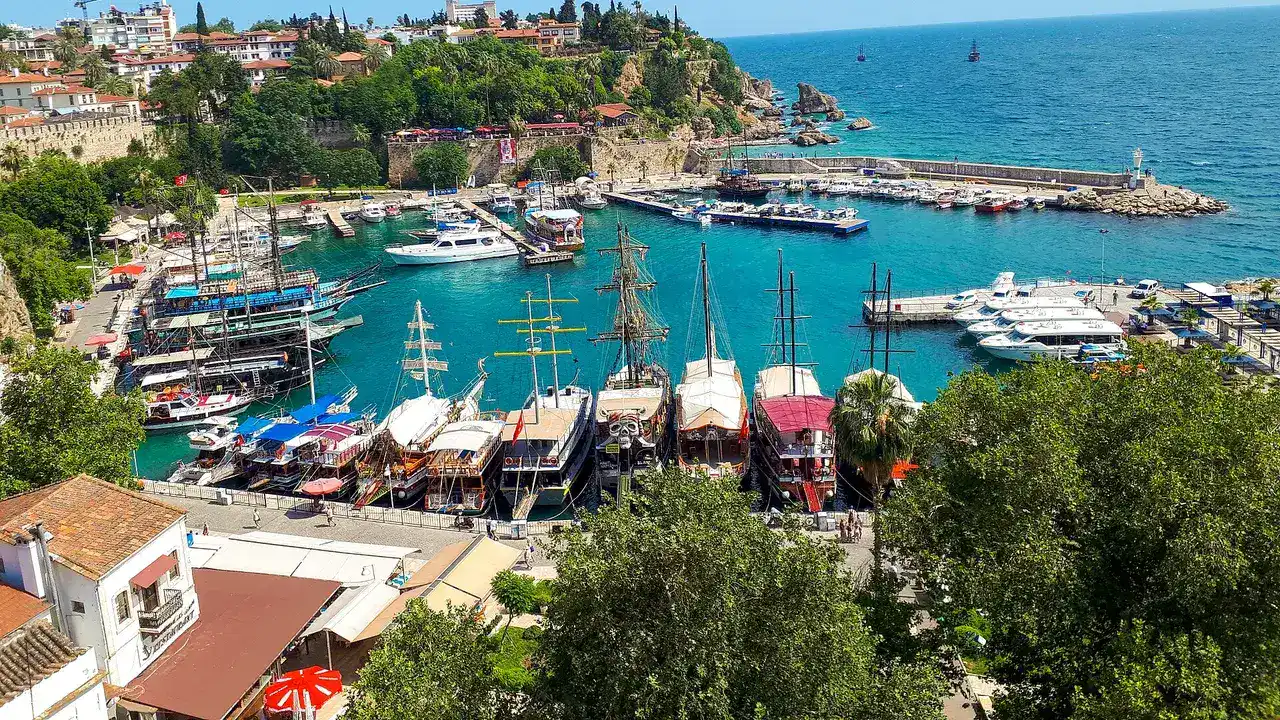
Leave the first day for Antalya itself, without rushing through museums. Start at Hadrian's Gate: this is the most recognizable entrance point into Kaleiçi. From here, walk downhill through the narrow streets to the Yivli Minaret, the Saat Kulesi clock tower, and the old harbor. In Kaleiçi, it is better not to make a strict plan: turn into side streets, step into courtyards with bougainvillea, and look at the wooden bay windows of old houses.
By lunchtime, head down to the harbor. You can take a short boat ride along the cliffs from there. If you do not want the touristy format, go up to Karaalioğlu Park instead: it has excellent views of the sea and the cliffs. In the evening, return to Kaleiçi, but choose dinner a little away from the busiest strip by the harbor: prices are gentler, and the food is often more consistent in quality.
Dedicate the second day to waterfalls. Upper Düden is inside the city, and you can get there by bus or taxi. It is a green park with paths, little bridges, and a cave behind the curtain of water. Lower Düden is interesting in a different way: the river falls from a cliff straight into the sea in the Lara area. The best view is from Düden Park, especially closer to sunset.
Kurşunlu is farther from the center, among pine trees. It is convenient to combine it with a rental car or a taxi for a few hours. In summer there may be less water, but the shade is a lifesaver in the heat. If you do not have a car, do not put all three waterfalls into one day: you will spend more time on transfers than on walking.
Day 3 and 4: Perge, Aspendos, and Side
Make the third day an ancient-history day. Perge is not far from Antalya, and it is relatively easy to reach by public transport with a transfer. In Perge, the gates, colonnaded street, agora, baths, and stadium are well preserved. It is better to come here in the morning: there is little shade, and the stone heats up quickly.
After Perge, it makes sense to continue to Aspendos. Its main draw is the Roman theater, one of the most impressive in southern Turkey. If you have a car, the Perge plus Aspendos pairing works well. Without a car, it is easier to take a tour or arrange a taxi with waiting time. There is also an aqueduct nearby, but many tourists limit themselves to the theater. If you love antiquities, set aside time for it too.
Day four is Side. This is already a proper trip to the coast east of Antalya. What is nice about Side is that the ruins are built right into the resort town: you walk through the streets, with columns, an amphitheater, and the remains of temples next to you. The main evening spot is the Temple of Apollo by the sea. It is hot and crowded here during the day, so a good plan is: arrive after breakfast, see the museum and amphitheater, swim, and head to the temple at sunset.
From Antalya to Side, you can get there by bus via Manavgat, then take a dolmuş to the old town. By car it is simpler: drive straight along the D400 highway, but parking near the old center may be paid.
If you plan to pay in cash, keep a supply of Turkish lira for transport, parking, tea, and small cafés. We covered what is best to bring with you separately: What money to take to Turkey.
Day 5, 6 and 7: Kemer, Tahtalı, Olympos, Chimera, and Pamukkale
Day five is for the western coast. Leave Antalya toward Kemer: the road runs between the sea and the mountains and is beautiful in its own right. In Kemer, you can walk around the marina, swim at the city beach, or continue to the cable car up Mount Tahtalı. Plan the ride up Tahtalı only in clear weather: if the summit is in the clouds, the impression will be weaker, and the ticket is not cheap.
If you do not have a car, look at tours from Antalya or a transfer from the cable car. By car, you can add Phaselis: an ancient city by bays with pine trees, where you can swim among the ruins. It is one of the most enjoyable formats on the coast: history in the morning, the sea in the afternoon.
Keep day six for Olympos and Chimera. Olympos is ruins in a valley, a beach, wooden guesthouses, and a more relaxed atmosphere than in the larger resorts. Nearby is Çıralı, a quiet village with a long beach. In the evening, go to the flames of Chimera: natural tongues of fire come out of cracks in the rock. The climb is not difficult, but it is better to take comfortable shoes and a flashlight. In summer, go after sunset; it is hot there during the day.
Day seven is Pamukkale, but only if you are ready for a long drive. From Antalya, this is a far outing: the white travertines, ancient Hierapolis, and Cleopatra's Pool look spectacular, but the road takes a lot of energy. By car or with a tour, leave very early. If your week is meant to be relaxed and beach-focused, you can replace Pamukkale with a free day in Antalya, a hammam, a market, or a return to your favorite beach.
Budget and tickets: what to set money aside for
Prices in Turkey change quickly, so treat the amounts as a guideline and check them before your trip on official museum websites, at ticket offices, and in apps. For archaeological sites, a museum card is sometimes a good deal, but the conditions for tourists and the list of included sites should be checked in advance.
| Expense | Guideline | Comment |
|---|---|---|
| Antalyakart and city rides | a single city ride costs several dozen lira | Needed for trams and buses |
| Taxi around the city | a short ride often starts from several hundred lira | BiTaksi is convenient for checking the route |
| Car rental | from 30-50 euros per day in low season | Plus fuel, parking, deposit |
| Entrance to Perge | current entrance price for Perge | May be included in museum cards |
| Entrance to Aspendos | current entrance price for the Aspendos theater | Check whether all areas are accessible |
| Side, museum, and theater | ticket price depends on the site | Some ruins in the city can be viewed freely |
| Olympos Teleferik | the cable car ticket is one of the most expensive items on the itinerary | Buy only when visibility is good |
| Pamukkale and Hierapolis | entrance price and surcharge for Cleopatra's Pool | Long day, possible tour expenses |
| Museum Pass | price, validity period, and list of sites for Museum Pass Türkiye or a regional card | Compare with the number of museums in your plan |
You can save a lot on food if you do not sit down every time at restaurants right by the most touristy spots. Look for lokanta, pideci, and kebapçı places in neighborhoods where locals eat. In Kaleiçi, you pay more for the atmosphere; in Muratpaşa and farther from the sea, it is easier to find a normal lunch without a view markup.
Tips in Turkey are not required everywhere, but in restaurants and with guides they are often expected. You will find situation-by-situation guidelines in the article Tipping abroad.
Frequently asked questions
Can you see Antalya without renting a car?
Yes, the city itself, Kaleiçi, Düden, and some beaches are easy to see by tram, bus, and taxi. Perge is also realistic to visit without a car. But Aspendos, Kurşunlu, Olympos, Chimera, and Pamukkale are much easier with a car, a tour, or a private transfer.
Is it worth going to Pamukkale from Antalya in one day?
It is worth it if it has been a long-time dream and you handle early starts well. The road is long, so the day will be tiring. If this is your first time in Turkey and you want more time by the sea, it is better to leave Pamukkale for a separate trip or an overnight stay in Denizli.
What should you choose, Side or Kemer, if you are short on time?
If you are interested in ruins and sunset by an ancient temple, choose Side. If you want mountains, bays, pine trees, and a cable car, choose Kemer and Tahtalı. For a beach day with nature, Kemer is usually more pleasant; for history without complicated logistics, Side is better.
When is the best time to follow this itinerary?
The most comfortable months for active walks are spring and fall. The itinerary also works in summer, but plan ruins and climbs for the morning, and leave the middle of the day for the sea, cafés, and resting in the shade.